























Baby Nappies and Animal Testing: Cruelty-Free Certification
Cruelty Free Diaper Certificate
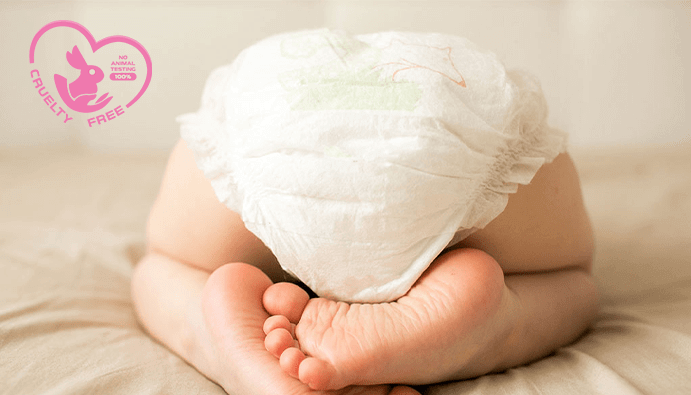
Animal testing refers to experiments conducted on animals to assess the safety of consumer products and their ingredients. When it comes to baby diapers, these tests come into focus for several category-specific reasons. First and foremost, baby diapers are in constant contact with the skin. Baby skin is much thinner, more permeable, and more sensitive than adult skin. The skin barrier is not yet fully developed and is vulnerable to external factors. For this reason, the effect of each ingredient used in baby diaper formulations on the skin is evaluated separately. The second reason is that baby diapers contain not only chemical components but also physical materials. Absorbent polymers, cellulose, nonwoven surface fabrics, adhesives, and elastic bands all come into contact with the skin. The effects of these materials on the skin have historically been evaluated through tests conducted on animals. Baby diaper formulations contain numerous ingredients and materials that come into contact with the skin. In the past, extensive animal testing was conducted to evaluate the effects of these ingredients on infant skin. The methods used included applying diaper material or an absorbent polymer solution to the shaved skin of test animals, followed by monitoring the skin’s reaction for several days. To assess the development of diaper rash (diaper dermatitis), tests were conducted in which the animals’ skin was kept in a moist, enclosed environment. These tests were viewed as both severely painful and scientifically questionable practices. For products in constant contact with the skin, such as baby diapers, a “cruelty-free” certification requires not only that the final product not be tested on animals but also that every single ingredient—including the absorbent polymer and the adhesive—have no history of animal testing. This illustrates how the scope of certification has expanded for non-cosmetic products. The most critical component of modern baby diapers is superabsorbent polymers (SAP). These sodium polyacrylate-based polymers rapidly absorb liquid, turning it into a gel and keeping the baby’s skin dry. The effect of these polymers on the skin has historically been evaluated through toxicity tests conducted on animals. Super-absorbent polymers are a component widely used not only in the cosmetics industry but also in the chemical industry. For this reason, their testing history is evaluated within a framework different from that of cosmetics regulations. In cruelty-free certification, the supply chain and testing history of these polymers are also examined. The absorbent layer of baby diapers typically contains cellulose derived from wood pulp. Cellulose is plant-based and contains no animal-derived ingredients. However, the testing history of bleaching agents and auxiliary chemicals used during the processing of cellulose must also be documented for cruelty-free certification. Non-woven surface fabrics, on the other hand, are generally produced from synthetic polymers such as polypropylene and polyester. A baby diaper’s fastening system consists of adhesive strips and elastic side panels. These materials come into direct contact with the skin and are constantly exposed to friction due to the baby’s movements. For this reason, they are evaluated separately for their potential to cause skin irritation. In the past, adhesives could contain animal-derived components. Gelatin-based adhesives were particularly common in older production methods. In modern baby diapers, however, acrylic-based synthetic adhesives are preferred. However, the testing history of the auxiliary substances used in the production processes of these adhesives must be separately documented for cruelty-free certification. Some baby diapers contain fragrance components, moisturizers, and lotions to leave a pleasant scent or protect the skin. These ingredients are applied to the inner surface of the diaper and come into direct contact with the skin. Fragrance components are evaluated separately for their potential to cause allergic reactions on sensitive surfaces such as a baby’s skin. Fragrance ingredients constitute one of the groups of ingredients with the highest potential for allergic reactions in the cosmetics industry. For this reason, they have historically been subject to extensive animal testing. Among the moisturizers used—such as lanolin, beeswax, and certain protein derivatives—some may be of animal origin and are not accepted under “cruelty-free” certification. The most critical function of a baby diaper is to keep the skin dry and prevent diaper rash. Diaper rash occurs as a result of the skin remaining moist for an extended period, coming into contact with urine and feces, and being exposed to friction. Verifying this mechanism requires category-specific physiological tests. In the past, some of these tests were conducted on animals. Diaper rash-like reactions were studied by creating conditions of moisture and a closed environment on animal skin. Today, the methods accepted for “cruelty-free” certification are in vitro skin models and human volunteer panels. In volunteer participants, the diaper’s moisture management, skin dryness, and irritation potential are evaluated under specific conditions. A baby diaper’s performance is measured by its absorbency rate and leak-proofing capacity. These parameters directly affect the baby’s comfort and skin health. These tests are typically conducted in a laboratory setting using artificial fluids. However, in some cases, parts of these tests have also been performed on animals. Absorbency and leak-proof performance were evaluated by securing diapers on animal models. Today, the method accepted for “cruelty-free” certification is in vitro testing conducted in a laboratory setting using artificial fluids. At the core of “cruelty-free” certification is the principle that the manufacturer must not have conducted any animal testing in the past five years. This principle applies not only to the final product but also to every ingredient that makes up the product and the auxiliary materials used in the production process. When it comes to baby diapers, this principle takes on added importance because the category falls under non-cosmetic products. For non-cosmetic products, “cruelty-free” certification does not fall under an absolute legal framework as it does for cosmetic products; therefore, the brand’s voluntary commitment and transparency become even more critical. In products that come into continuous contact with the skin, such as diapers, animal-free testing methods have become significantly more widespread in recent years. These methods eliminate the use of animals while yielding results that more closely mimic human biology. Artificial skin models are three-dimensional tissue models produced from human skin cells. Tests conducted on these models make it possible to assess the potential irritating effects of diaper materials and absorbent polymers on the skin. Moisture and closed-environment models allow for the study of conditions that lead to diaper rash without the use of animals. Laboratory absorbency tests measure the diaper’s performance using synthetic fluids. Computer-aided modeling can predict a material’s potential effects on the skin. Human volunteer panels are used to evaluate a product’s performance, comfort, and skin compatibility under real-world usage conditions. There are a few practical tips for those who want to choose a cruelty-free option when buying baby diapers. First, check the certification logo on the product and verify whether it belongs to an independent certification organization. There is a difference in reliability between a symbol designed by the brand itself and an independent certification. Reading the ingredient list is also important. Ingredients such as lanolin, beeswax, gelatin-based adhesives, silk protein, and chitosan can be found in baby diapers. The use of these ingredients is particularly common in lotion- or cream-infused diapers. Additionally, the source of the adhesive used in the diaper’s fastening strip requires careful attention. For this reason, the certification logo and the ingredient list are two essential sources of information that should be evaluated together. A “cruelty-free” baby diaper certification is not merely a label for brands; it is a tool that encourages more transparent management of production processes. In a product that combines super-absorbent polymers, cellulose, nonwoven surface fabrics, adhesives, and elastic bands, documenting the testing history of each material and component requires a comprehensive supply chain analysis. This certification also offers consumers the opportunity to make an informed choice. Rather than focusing solely on a diaper’s absorbency performance and price, it becomes possible to evaluate the ethical commitment behind the product. This shifts the product selection process to a more holistic foundation for both the brand and the parent. Although baby diapers are not classified as cosmetics, they constitute a unique category regarding animal testing due to their constant contact with the skin and the sensitivity of a baby’s skin. Every stage—from the testing history of super-absorbent polymers to the source of adhesives, and from diaper rash formation tests to absorbency and leak-proofness evaluations—is specifically addressed in cruelty-free certification. Lotion-infused diapers, fragrance components, and non-woven surface materials are evaluated under separate headings as category-specific topics. With the advancement of animal-free testing methods and growing consumer awareness, this category is becoming more transparent for both brands and parents. Every diaper change is, in fact, a choice; and the production process behind that choice is just as important as the product itself.
Although baby diapers are not cosmetic products, they are among the consumer products that come into contact with the skin for the longest period of time. A baby spends nearly the entire day in a diaper, and this contact is constant, uninterrupted, and occurs on extremely sensitive skin. This characteristic gives baby diapers a unique position in cruelty-free certification. In this article, we examine the history of animal testing specifically for baby diapers, the category-specific risk areas, and the current state of animal-free testing methods.
Why do animal tests come up in the context of baby diapers, even though they are non-cosmetic products?
The History of Animal Testing for Infant Skin Sensitivity and Irritation
Absorbent Polymers and Animal TestingCellulose and non-woven surface materials
Adhesives, elastic bands, and animal testing
The Relationship Between Fragrance, Moisturizer, and Lotion Ingredients and Animal Testing
Diaper rash and physiological tests
The Relationship Between Leak-Proofing and Absorbency Tests and Animal Use
The Significance of Avoiding Animal Testing
Animal-Free Testing Methods and Diapers
What to Look for When Choosing Baby Diapers
The Contribution of Certification to the Baby Diaper Category
CLICK HERE TO GET A PRICE OFFER.