























"Nitrate-Free" Label: On Processed Meat Products
Nitrate-Free Analyses
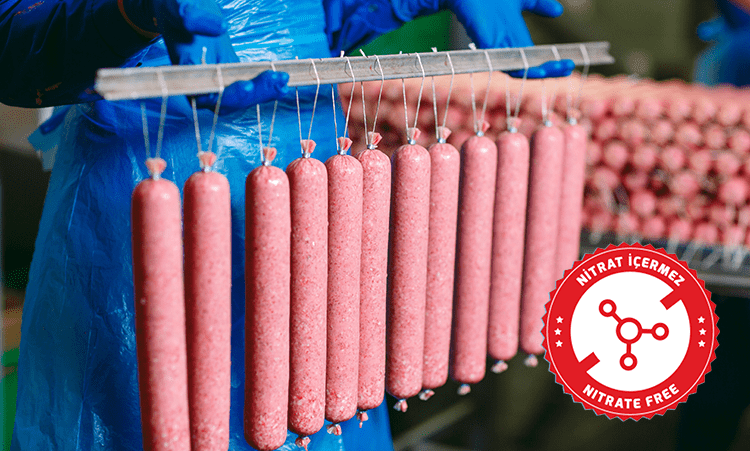
While shopping for salami, sausage, or pastrami in the deli section, you noticed the words “nitrate-free” on the packaging. This claim led you to believe the product was more natural and healthier, so you added it to your cart. But does that product really not contain nitrates, or do the nitrates simply come from a different source? The “nitrate-free” label is one of the most controversial and misleading statements in the world of food labeling.
The “nitrate-free” label, in its simplest terms, states that no synthetic nitrates or nitrite salts have been directly added to a product’s formulation. This claim is frequently encountered, particularly in processed meat products. However, a critical distinction comes into play here: From a regulatory standpoint, there is a sharp difference between “added nitrates” and “naturally occurring nitrates,” and manufacturers can exploit this distinction to create the perception of a “nitrate-free product” among consumers. In reality, natural ingredients such as celery powder, beet juice concentrate, or spinach extract also contain high levels of nitrates, and nitrates from these sources are chemically indistinguishable from their synthetic counterparts.
Nitrates and Nitrites: Their Functions and Roles in Food
Nitrates and nitrites are two fundamental preservative compounds that have been used in processed meat products for centuries. The presence of these substances in the food industry is not limited to extending shelf life; they also give the product its characteristic pink color, create the characteristic cured meat flavor, and, most importantly, provide protection against deadly food poisonings such as botulism.
The table below shows the forms, functions, and legal limits of nitrates and nitrites when used as food additives:
| Food Additive | E Number | Primary Function | Products in Which It Is Most Commonly Found | Legal Maximum Residue Limit |
|---|---|---|---|---|
| Potassium Nitrate | E252 | Preservative, color fixative, antimicrobial | Salami, sausage, pastrami, ham, fermented sucuk | 150–250 mg/kg (varies by product) |
| Sodium Nitrate | E251 | Preservative, color fixative, antimicrobial | Cured meat products, cheese, canned fish | 150–250 mg/kg (varies by product) |
| Sodium Nitrite | E250 | Color fixative, antimicrobial (especially against Clostridium botulinum) | All cured meat products, bacon, ham | 50–150 mg/kg (varies by product) |
| Potassium Nitrite | E249 | Color fixative, antimicrobial | Cured meat products, canned meats | 50–150 mg/kg (varies by product) |
Processed meat products produced without these additives would differ significantly from what consumers are accustomed to in terms of shelf life, color, and flavor. A grayish-brown color, a different flavor profile, and a much shorter shelf life are typical characteristics of nitrate-free products. This is precisely why producers are turning to natural nitrate sources to achieve the same results without using synthetic additives.
The Critical Difference Between Synthetic Nitrates and Natural Nitrate Sources
The greatest confusion caused by the “nitrate-free” label stems from the legal distinction between synthetic and natural nitrates. While food regulations classify chemically derived nitrate salts added directly as food additives, they consider natural ingredients such as celery powder or beet juice to be food or food components. This legal loophole allows manufacturers to label their products as “nitrate-free” or “no added nitrates” while actually incorporating nitrates through natural sources.
Production with Synthetic Nitrates
Food additives coded as E249, E250, E251, or E252 are added directly to the product. These codes or their chemical names must be clearly stated on the label. They appear in the “preservatives” section of the ingredients list. The amount can be precisely controlled, and it is easy to keep it below legal limits.
Production Using Natural Nitrate Sources
Ingredients such as celery powder, celery juice concentrate, beet juice, spinach extract, or Swiss chard powder are added to the product. On the label, these ingredients are listed as natural flavors or plant extracts. The product may carry a “nitrate-free” or “no additives” label. However, the nitrate content in the final product may not be lower than that of the synthetic version.
As this comparison shows, a product labeled “nitrate-free” may be quite rich in natural nitrates derived from celery powder, even though it does not contain synthetic nitrate salts. In fact, some studies indicate that controlling the amount of nitrates from natural sources is more difficult and that the final product may contain higher nitrate levels compared to the synthetic version.
Legal Regulations and Oversight Mechanisms
The Turkish Food Codex Regulation on Food Additives provides detailed regulations regarding the conditions for the use of nitrate and nitrite salts. The regulation clearly specifies the amounts of nitrate or nitrite that may be added to which products, as well as residue limits and labeling requirements. For a product to be labeled as “nitrate-free,” the ingredient list must not contain any food additives coded as E249, E250, E251, or E252.
The inspection process consists of the following stages:
- Formulation and Recipe Review: The manufacturer submits a list of all raw materials used, along with their technical specifications, to the inspection body. It is documented that no synthetic nitrate salts are used.
- Laboratory Analyses: Samples taken from the final product are tested in accredited laboratories for nitrate and nitrite residues. The total nitrate content from both synthetic and natural sources is measured.
- Label Compliance Check: All claims on the product label are checked for compliance with laboratory results and regulations. If misleading statements are identified, corrections are requested.
- Periodic Re-inspection: Following certification, the product’s compliance with the standard is monitored through annual routine inspections and unannounced sampling.
The Labels That Confuse Consumers the Most
While browsing supermarket shelves, you may come across many different label statements regarding nitrates and nitrites. Each of these statements has a different legal basis and meaning. Below, you will find the four most common statements and their true meanings:
“Does Not Contain Nitrates”
This statement indicates that no synthetic nitrate or nitrite salts have been added to the product. However, it may contain natural sources of nitrates, such as celery powder. It does not guarantee the total nitrate content.
“No Added Nitrates or Nitrites”
This is slightly clearer than the “Does Not Contain” statement but still contains the same legal loophole. It excludes nitrates from natural sources.
“Contains No Preservatives”
This statement is much broader in scope. It guarantees that the product contains no preservative additives. It excludes not only nitrates and nitrites but also other preservatives such as sorbates and benzoates.
“Naturally Cured”
This is purely a marketing term and has no legal binding force. It generally implies—but does not guarantee—the use of natural sources, such as celery powder, instead of synthetic nitrates.
Label-Reading Strategy for the Informed Consumer
When you come across a “nitrate-free” label, do not rely on this information alone to make a final decision about the product. You can make a more informed assessment by following these steps:
- Read the entire ingredient list. Terms such as “celery powder,” “celery juice concentrate,” “celery extract,” “beet juice,” “beet powder,” “spinach powder,” and “Swiss chard extract” indicate that the product contains nitrates from natural sources.
- Check the E numbers. If any of the codes E249, E250, E251, or E252 appear on the ingredient list, it means synthetic nitrates or nitrites have been added to the product.
- Look for “ascorbic acid” or “sodium ascorbate.” The presence of these ingredients indicates that the manufacturer has taken steps to prevent the formation of nitrosamines, which is a positive sign.
- Pay attention to the product’s color. A processed meat product that has not had nitrates added naturally—one that is completely nitrate-free—will be grayish-brown in color. A bright pink color is an indication of nitrate presence.
- Question the shelf life. Fresh meat products containing no preservatives have a very short shelf life. A product that lasts for weeks despite a “nitrate-free” label may contain natural sources of nitrates.
The “nitrate-free” label is one of the most complex and potentially misleading areas in the world of food labeling. When you see this label, remember that while the product does not contain synthetic nitrate salts, it may still be rich in nitrates from natural sources. If you want to make a healthier choice, focus not only on the “nitrate-free” statement but also on the entire ingredient list, the natural ingredients used, and any independent certification logos, if present. Remember that the healthiest processed meat product is the one that’s been processed as little as possible.